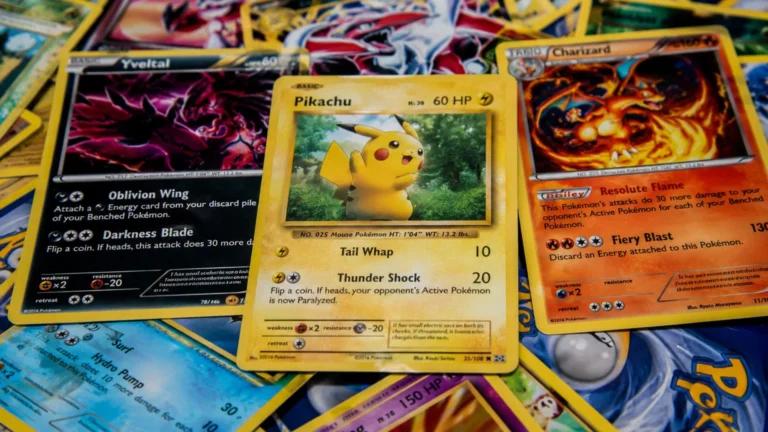



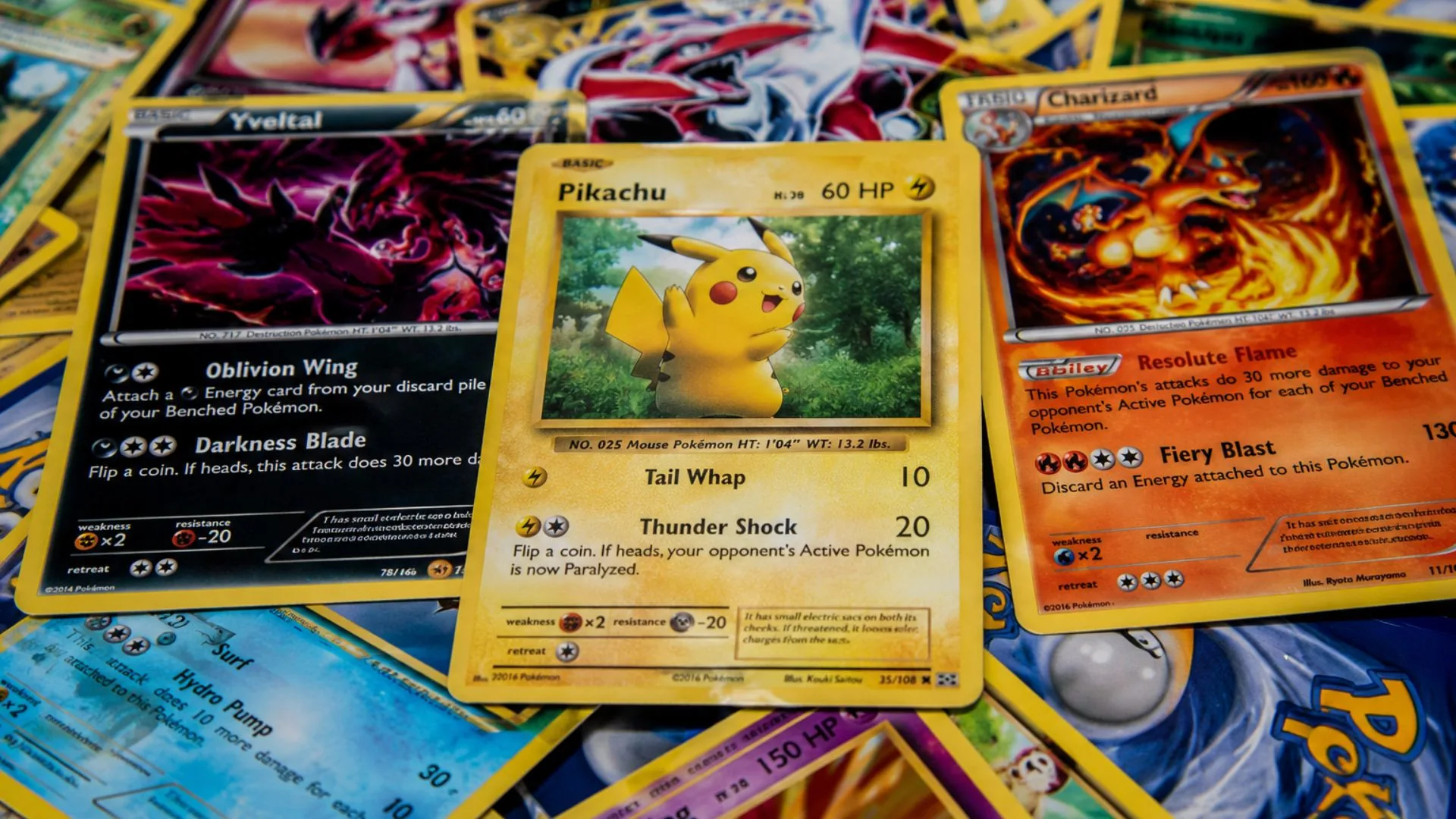
Here’s the thing: Pokémon cards serve a dual purpose that makes them absolutely unique in the world of collectibles. On one hand, they’re trading cards used to play a game — a strategy-heavy TCG where you build a deck of 60 cards, evolve your Pokémon, and battle opponents.
On the other, they’re collectible trading cards kept as a hobby, displayed in binders, graded in plastic slabs, and treated like modern art.
Think about it. You can play the actual Pokémon Trading Card Game with a $50 deck, or you can own a single piece of cardboard worth more than a house in Ohio. Same franchise. Same card stock. Completely different worlds.
The Pokémon TCG launched in Japan in 1996, then hit North America in 1999. Since then, it’s become the most successful trading card game in history. Target alone is on track to exceed $1 billion in trading card sales this year, and Pokémon cards account for the majority of that volume.
Where Can You Find Pokémon Cards Near Me Right Now?
Look, I’ve been hunting Pokémon cards for years. I’ve walked into empty Target shelves more times than I’ve found a restock. But the game has changed, and if you’re still doing it blind, you’re losing.
The Big Box Strategy: Target, Walmart, Costco
Let’s start with the obvious ones. Target Pokémon cards are usually stocked near the front registers or in the toys section, but here’s the insider secret: check the electronics section too. Some stores hide them there. Target has ramped up their trading card game dramatically — their business grew nearly 70% year-to-date in 2025, and they’re launching new drops weekly.
Walmart Pokémon cards are often in the trading card section near the front checkout lanes. They also carry online exclusives and bigger collection boxes.
Costco Pokémon cards have become legendary — and I mean that in both good and bad ways. The wholesale giant offers massive bundles at competitive prices, but demand has gotten so insane that they’re now testing a queue system on their website to prevent bots from scooping up everything within seconds . And yes, people have literally fought over them in parking lots. It’s not a joke.
Tech Your Way to Victory
If you’re still just “dropping by” stores hoping for luck, you’re doing it wrong. Here’s what the pros use:
- TCG Restock App: This is your best friend. It alerts you the moment Pokémon cards hit shelves near you. Search by ZIP code, radius, or specific sets. Community reports confirm or deny restocks in real-time, and you can upload photos to help others .
- TamerMap: An interactive map showing Pokémon cards nearby, including kiosks, card shops, and vending machines. It uses heatmaps to show which areas have the most hunting activity, helping you plan efficient routes .
- Card Shows Locator: For serious collectors who want to meet vendors and dealers in person, this tool helps you find local card shows where you can buy, sell, and trade. Alan Narz, the founder, has consulted for The Topps Company, the NFL, and MLB — the guy knows his stuff.
⚡ Top 5 Pokémon Cards · Hobby & Play
| Card & Set | Rarity / Specs | Market Value (USD) | Key Feature |
|---|---|---|---|
|
Mega Gengar ex SIR Ascended Heroes · #284/217
SIR ⭐ chase
|
|
$1,106
▲ +12% (Aug–Sep)
|
most expensive English 2026 card; first Mega Gengar since XY era [citation:2][citation:9] |
|
Pikachu ex SIR Ascended Heroes · #277/217
SIR 🌈 full art
|
|
$386
▲ +8% (Q3)
|
iconic Pikachu; simple yet highly sought-after design [citation:1][citation:9] |
|
Mega Charizard Y ex Ascended Heroes · #294/217
Mega Hyper 🔥 gold
|
|
$437
▲ +5% (steady)
|
one of two Mega Hyper Rares in Ascended Heroes; strong long-term hold [citation:2][citation:9] |
|
Mega Dragonite ex SIR Ascended Heroes · #290/217
SIR ✨ pastel
|
|
$708
▲ +20% (undervalued)
|
“evolution story” artwork; considered a sleeper hit of 2026 [citation:2][citation:9] |
|
Umbreon ex SIR Prismatic Evolutions · #??
SIR 🌙 moon
|
|
$1,000+
▲ +25% (YTD)
|
still the most valuable modern card heading into late 2026; iconic “Moonbreon” status [citation:2][citation:11] |
What Are the Rarest Pokémon Cards in 2026?
If you’re here for the big numbers, let’s get into it. Some of these cards are so rare that fewer than ten copies exist in the entire world. And the prices? Absolutely unhinged.
The Crown Jewel: Pikachu Illustrator
The Pokémon Illustrator card is the holy grail. Only about 39 were awarded through CoroCoro illustration contests between 1997 and 1998. In February 2026, a PSA 10 copy sold for **$16,492,000** at Goldin Auctions, making it the most expensive trading card ever sold at auction . Yes, you read that right. Nearly $16.5 million for a single card.
The Trophy Pikachu Trio
In 1997, the first official Japanese tournament awarded three versions of a Trophy Pikachu — gold (No. 1 Trainer), silver (No. 2 Trainer), and bronze (No. 3 Trainer). About four of each were awarded. The gold No. 1 Trainer, with artwork by Mitsuhiro Arita, sold for $982,100 in PSA 8 condition in March 2026 .
But here’s the crazy part: a bronze No. 3 Trainer in PSA 10 sold for $1,769,000 in May 2026. That’s a third-place prize outselling every first-place trophy in the hobby’s history . Why? Population. Only one copy above PSA 8 exists. Scarcity is everything.
Legendary Collection Reverse Holos
The Legendary Collection (2002) reverse holos with their “fireworks” pattern have become ultra-desirable. In a single June 2026 Fanatics auction, several set records:
- Reverse Holo Gengar (PSA 10): **$408,000** — up from $7,357 in 2024
- Reverse Holo Pikachu (PSA 10): **$204,000** — up from $9,200 in 2025
- Reverse Holo Eevee (PSA 10): $66,000
These gains are absolutely insane, showing how dynamic and volatile the Pokémon card market is right now.
Japanese Exclusives to Know
If you want to go down a deeper rabbit hole, look at Japanese Pokémon cards. Japan got the TCG two years before the West, and some of the rarest cards never crossed the Pacific. Examples include:
- Tamamushi University Magikarp (1998 Promo): Only passed to about 1,000 kids who passed a punishing exam. Raw copies trade for $3,500-$5,500, graded 8 copies north of $20,000 .
- No Rarity Blastoise (Japanese Base Set): The earliest print run without rarity symbols. A low population card that’s a true first-printing exclusive.
Are Pokémon Cards a Good Investment in 2026?
I get asked this constantly. And honestly? The answer is: it depends on what you buy and when you sell.
The Vintage Comeback
Here’s the good news: vintage is climbing again. PSA 10 1st Edition holos from Base Set, Jungle, and Fossil are all up 15-25% from their 2024 lows. Shadowless Base Set cards have seen renewed interest from collectors priced out of 1st Edition. Neo-era holos (Genesis, Discovery, Revelation, Destiny) are having a major moment, with some cards up 30-50% year-over-year .
Why? Because the post-2021 boom correction is essentially over. Cards that were going to lose value already did. The panic selling has stopped, and genuine collector demand is pushing prices upward again.
The Modern Reality Check
Modern cards (Sword & Shield through Scarlet & Violet) are a mixed bag. The pattern? Chase cards from out-of-print sets are doing well. Evolving Skies alternate arts continue climbing. But non-chase cards? Mostly flat or declining.
The 2026 30th anniversary celebrations are also shaking things up. Target launched a massive Pokémon x Target collaboration in June with over 40 products . And Pokémon Day 2026 collections feature special promo cards like a Pikachu with a Pokémon Day stamp, plus booster packs.
Grading Matters More Than Ever
The grading landscape shifted in 2025 when Collectors (PSA’s parent company) acquired Beckett (BGS) and SGC, giving them roughly 79% of the grading market. This consolidation means less competition and potentially higher grading fees down the road. If you’re serious about investing, consider TAG Grading (AI-powered) or CGC as alternatives.
What Are Japanese Pokémon Cards, and Why Are They Special?
If you want to understand the top tier of this hobby, you need to understand Japanese cards. Here’s why they matter.
Two Years Ahead
Japan got the Pokémon TCG in 1996. The US got it in 1999. That two-year head start created a treasure trove of exclusives — cards that were never printed in English, unique promo sets, and first-edition print runs with quirks the rest of the world never saw.
Exclusive Artwork and Rarities
The most valuable Japanese exclusives include:
- Poncho-Wearing Pikachu (Mega Charizard X): Sold only through Japanese Pokémon Center boxes. Raw copies run around $5,000**, graded 10s have hit **$24,000 .
- Masaki Alakazam (1998-99 Promo): A cosmos holo promo obtained by mailing in a specific Pokémon. Raw copies are attainable in the $300-$700 range, but high-grade examples are rare and expensive .
- Master Ball Mirror and Poké Ball Mirror: Newer Japanese set exclusives that add unique textures and patterns to cards.
Understanding Japanese Rarity Symbols
If you’re buying Japanese cards, you need to know the rarity system :
| Rarity | Meaning |
| C | Common |
| U | Uncommon |
| R | Rare (holographic border and artwork) |
| RR | Double Rare (Pokémon ex, Pokémon V) |
| SR | Secret Rare (full art, textured) |
| SAR | Special Art Rare (full illustration, highly desired) |
| AR | Art Rare (beautiful illustrations, affordable) |
How Can You Check Your Pokémon Cards Value?
Got a binder full of cards from the 90s? Maybe bought some packs recently and wondering if you hit the jackpot? Here’s how to assess your collection.
Step 1: Identify the Set and Rarity
Look at the bottom-right corner of the card. The set symbol tells you which expansion it’s from. The rarity symbol (circle = common, diamond = uncommon, star = rare) is usually near the bottom-left corner.
Step 2: Check the Condition
Condition is everything. A PSA 10 (perfect) copy of the same card can be worth 100x more than a PSA 7. Look for scratches, white edges on the back, centering issues, and corner wear. In the 1997 Trophy Pikachu market, a bronze card in PSA 10 sold for $1.77 million because only one exists in that condition.
Step 3: Use Price Tracking Tools
Websites like TCGPlayer, eBay sold listings, and specialized platforms like Misprint offer price history tools. The market is volatile — for example, a PSA 10 Legendary Collection Squirtle sold for $6,500 in February**, then **$32,400 in June . That’s a nearly 5x increase in four months.
Step 4: Consider Grading
If you think you have something special, consider sending it to a grading company. PSA, CGC, BGS, and TAG are the majors. A card in a slab is easier to value and sell.
Question: How can I find Pokémon cards near me right now?
Answer: Use apps like TCG Restock (real-time restock alerts) and TamerMap (interactive map of nearby kiosks, card shops, and vending machines). Check Target, Walmart, and Costco — Target’s trading card business is on track to exceed $1 billion in 2026 sales.
Question: What are the most expensive Pokémon cards?
Answer: The Pikachu Illustrator is the most expensive, selling for $16.49 million in 2026. Other top cards include the 1997 Trophy Pikachu gold No. 1 Trainer ($982,100) and Legendary Collection reverse holos (Gengar hit $408,000 in 2026).
Question: Are Pokémon cards from Costco worth buying?
Answer: Yes, Costco often offers exclusive bundles at competitive prices. However, demand is extremely high — they’ve implemented a queue system to combat bots, and physical store restocks have occasionally led to chaotic scenes.
Question: What’s the difference between English and Japanese Pokémon cards?
Answer: Japanese cards are often released earlier (Japan got the TCG in 1996, the US in 1999) and have exclusive sets, promo cards, and artwork not available in English. They also have a different rarity system (SAR, AR, etc.) and can sometimes command higher prices for certain exclusives.
Question: How do I know if my Pokémon cards are worth money?
Answer: Check the set symbol, rarity, and condition. High-value cards usually have low populations (few copies in PSA 10) and strong collector demand. Use eBay sold listings and price history tools to track current market values.
Bottom Line + Your Next Move
Pokémon cards in 2026 are more than just cardboard — they’re a billion-dollar ecosystem spanning gameplay, collecting, and investing. The market has stabilized after the 2021 boom and 2022-2023 correction. Vintage is climbing again (up 15-50% year-over-year), modern chase cards from out-of-print sets are performing well, and exclusive Japanese cards offer unique opportunities.
Your next move:
- If you’re hunting, get tech — use TCG Restock, TamerMap, and Card Shows Locator
- If you’re investing, buy vintage, skip modern non-chase, and grade everything significant
- If you’re just curious about your collection, check condition, identify the set, and compare with recent sales
The Pokémon TCG market isn’t going anywhere. It’s evolved into a multi-generational phenomenon with staying power. Just remember: patience beats panic, condition beats hype, and knowledge beats luck every single time.
Read More: Nintendo Switch OLED
About the Author