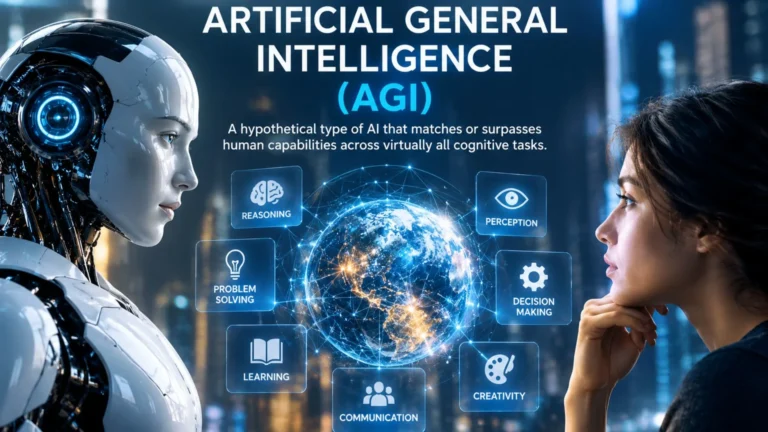





Artificial general intelligence (AGI) represents the next frontier of advanced AI systems—machines that can match or surpass human-level intelligence across virtually all cognitive tasks.
What Is Artificial General Intelligence, Really?
Let me start with a confession. I’ve been writing about AI for over 15 years, and I’ve never seen a term cause as much confusion as “Artificial General Intelligence.” Every time I think I’ve nailed the definition, someone moves the goalpost.
Here’s the thing: artificial general intelligence is the holy grail of AI research—a hypothetical system that can match or surpass human capabilities across virtually all cognitive tasks. Unlike the AI you use today (which excels at specific jobs), AGI would be a machine that can write poetry, code software, diagnose diseases, and debate philosophy with equal skill.
Think of it this way: today’s AI is a specialist. AGI is a polymath. A true jack-of-all-trades that doesn’t just memorize patterns but actually understands the world.
Quick Answer: Artificial general intelligence (AGI) is a hypothetical type of AI that can perform any intellectual task a human can, with human-level competence across all domains. Unlike narrow AI systems that excel at specific functions like translation or image recognition, AGI would possess general reasoning, learning, and problem-solving abilities.
What Is Artificial General Intelligence in Practice?
You’re probably wondering: “If AGI doesn’t exist, why does everyone keep talking about it?” Fair question.
The artificial general intelligence definition varies wildly depending on who you ask. OpenAI defines AGI as “systems that outperform humans at most economically useful tasks” . Google DeepMind focuses on versatility—AGI should surpass humans at useful work and learn new skills with scarce data.
What is artificial general intelligence in real terms? It’s an AI that can:
- Transfer knowledge from one domain to another without retraining
- Adapt to entirely new situations it hasn’t been explicitly programmed for
- Understand context, nuance, and ambiguity like a human would
- Learn continuously from experience, not just from massive datasets
According to a recent IEEE paper, AGI embodies sophisticated features including multi-modality, generality, adaptability, autonomy, and learning. That’s fancy talk for: “It can do lots of different things, figure stuff out on its own, and get better over time.”
Key Takeaway:
- AGI is about general intelligence, not specialized skills
- There’s no universal definition—everyone has their own interpretation
- The core idea is a machine that can do anything a human brain can do
Artificial General Intelligence Examples: How Close Are We?
Here’s where things get spicy. A UC San Diego study published in Nature argued that by reasonable standards, current large language models already constitute AGI. Yes, you read that right. Some experts believe we’re already there.
But don’t pop the champagne yet. Other researchers strongly disagree. A 2026 survey on the foundations of AGI emphasizes that despite significant advances, current models remain restricted to narrow, domain-specific applications. They lack true general intelligence and adaptability.
So what are the most impressive artificial general intelligence examples we’ve seen so far?
Google DeepMind’s Gemini Breakthrough
In September 2025, Google DeepMind claimed a “historic” AI breakthrough. A version of Gemini 2.5 won a gold medal at the International Collegiate Programming Contest in Azerbaijan. It solved 10 out of 12 complex problems—including one that stumped every human team. The AI found a solution using the minimax theorem, a game theory concept, in under 30 minutes.
Google called this “a profound leap in abstract problem-solving—marking a significant step on our path toward artificial general intelligence” .
OpenAI’s Math Olympiad Feat
Around the same time, OpenAI’s system earned a gold medal score at the International Mathematical Olympiad. The AI completed five of six problems correctly, scoring 35 out of 42 points—the minimum required for gold. Only 4% of human competitors outperformed it.
The kicker? The team used a general-purpose reasoning model designed to “think” through problems by breaking them into steps, checking its own work, and adapting its approach. They deliberately avoided math-specific training because the goal was building AGI, not winning competitions.
Key Takeaway:
- AI systems are achieving gold-medal performance in coding and math
- These breakthroughs demonstrate reasoning abilities previously thought impossible
- Whether this qualifies as AGI depends on your definition
Artificial General Intelligence — hypothetical AI that matches or surpasses human capabilities across virtually all cognitive tasks
| Specification | Description & characteristics |
|---|---|
| Cognitive scope | General-purpose — performs any intellectual task that a human can, from abstract reasoning and creative writing to scientific discovery and strategic planning. Not limited to a single domain. |
| Autonomy | Goal-directed autonomous AI capable of setting its own sub‑goals, learning from experience, and adapting to novel environments without explicit retraining. Demonstrates transfer learning and self‑improvement. |
| Reasoning & logic | Human‑level logical reasoning — handles deductive, inductive, and abductive inference. Can solve unseen problems (e.g., mathematical proofs, code debugging) with few‑shot or zero‑shot generalisation. |
| Multimodal understanding | Multimodal AI — integrates vision, language, audio, and sensor data. Understands context across modalities, enabling rich interaction with the physical and digital world (e.g., robotics, augmented reality). |
| Learning paradigm | Continuous & lifelong learning — leverages deep learning, neural networks, and transfer learning to accumulate knowledge over time. Does not forget previous tasks (mitigating catastrophic forgetting). |
| Generality & adaptability | General‑purpose AI — adapts to new tasks, cultures, and languages without task‑specific engineering. Exhibits emergent abilities like theory of mind, planning, and counterfactual reasoning. |
| Knowledge representation | Uses hybrid symbolic‑subsymbolic representations. Combines neural networks with structured knowledge graphs to enable logical reasoning and explainable decisions. |
| Scalability & compute | Massively parallel — designed to scale across distributed systems. Requires exascale compute but optimised via sparse attention, mixture of experts, and neuromorphic hardware. |
| Safety & alignment | value alignment — built with robust oversight, interpretability, and fail‑safe mechanisms. Aims to be provably aligned with human values, with corrigibility and uncertainty awareness. |
| Interaction & communication | Natural language understanding and generation at expert level. Engages in dialogue, negotiation, and collaborative problem‑solving. Supports multimodal AI interfaces (voice, gesture, text). |
| Creative & generative capacity | Generative AI — produces original art, music, scientific hypotheses, and engineering designs. Exhibits divergent thinking and serendipitous insight, not just pattern replication. |
| Key differentiator | Surpasses narrow AI — unlike specialised systems (e.g., AlphaFold, GPT‑4), AGI demonstrates human‑level intelligence across *all* cognitive tasks, including social, emotional, and abstract reasoning. |
The Three Theories of AGI
After years of watching this debate unfold, I’ve identified three camps in the AGI conversation. Understanding them helps cut through the hype.
Camp 1: AGI Is Already Here
UC San Diego researchers argue that frontier LLMs already meet reasonable AGI standards. Their argument:
- AGI doesn’t need to be perfect—humans aren’t either
- It doesn’t need to beat every human at every task
- It doesn’t need to follow human models of cognition
They point out that qualities we associate with human intelligence—having a body, being conscious, avoiding errors—are actually inessential to general intelligence. Stephen Hawking communicated through text, yet nobody questioned his intelligence.
Camp 2: AGI Is Coming Soon (5-10 Years)
This is the industry consensus. A comprehensive review in Progress in Quantum Electronics predicts AGI within five to ten years. Key drivers include:
- Exponential reduction in computing costs
- Massive increases in model size
- Growing context windows and memory
- Inference-time scaling for enhanced reasoning
OpenAI’s Greg Brockman announced the “AGI era” has arrived, calling it “a spiritual concept” that people get to define for themselves.
Camp 3: AGI Is Impossible
Skeptics point to tacit knowledge—things we know but can’t explain. Cognitive scientists have identified knowledge domains that machine learning struggles with:
- Common sense reasoning
- Daily interactions with physical environments
- Feelings, moods, and interpretations
- Accumulated skills and talents
- Social and historical culture
Machine learning pioneer Michael Polanyi famously said: “We know more than we can say.” If true knowledge can’t be codified, AGI may remain forever out of reach.
Key Takeaway:
- Experts disagree on whether AGI exists, is coming soon, or is impossible
- The debate often conflates general intelligence with superintelligence
- Your view likely depends on how you define “intelligence”
Why the AGI Definition Matters
You might be thinking: “Who cares about definitions? Just tell me what these machines can do!”
Look, I get it. But the artificial general intelligence definition actually matters for three reasons:
Money and Power
Companies like OpenAI are raising billions based on AGI promises. Dutch AI advisor Ilyaz Nasrullah argues that AGI talk is primarily marketing. “It ensures people talk about OpenAI. It doesn’t matter if people are for or against—they’re talking about the company.”
Regulation
If we can’t agree on what AGI is, how do we regulate it? European AI laws already struggle with this ambiguity. A clear artificial general intelligence definition is essential for governance.
Human Exceptionalism
The AGI question challenges our understanding of what makes humans special. A Swiss researcher noted: “You’re comparing a submarine to a human swimmer. It makes no sense—one is a machine based on computing power, the other is a living being” .
Key Takeaway:
- AGI definitions shape investment, regulation, and societal expectations
- The term is often used strategically rather than scientifically
- How we define AGI determines how we respond to it
AGI vs. Current AI: What’s the Difference?
Let’s get practical. Here’s how AGI would differ from the AI you use today:
| Feature | Current AI (Narrow AI) | AGI |
| Task range | Specific domains | Any cognitive task |
| Learning | Training on massive datasets | Continuous learning from experience |
| Adaptation | Fine-tuning for each new task | Transfer knowledge across domains |
| Understanding | Pattern recognition | Genuine comprehension |
| Common sense | Limited or absent | Human-level reasoning |
| Creativity | Generates based on patterns | Genuinely novel creation |
Current AI systems, including impressive LLMs, are still narrow. They excel at specific tasks but fail spectacularly outside their domain. AGI would be different—it could apply knowledge from one situation to entirely new challenges.
Key Takeaway:
- Today’s AI is a specialist; AGI would be a generalist
- AGI would transfer learning across domains
- We’re not there yet, despite impressive progress
The Challenges Standing in AGI’s Way
Let me be brutally honest: achieving artificial general intelligence won’t be easy. Here are the biggest hurdles:
Computing Power
AGI will require exponentially more hardware and energy than current systems. AI data centers could need 10 gigawatts of additional power capacity. One inference from a large language model consumes as much energy as ten Google searches.
Data Scarcity
High-quality training data is becoming a bottleneck. Researchers project that human-generated public text data could run out as early as 2026. AGI will require significantly more data to acquire generalized, cross-domain knowledge.
Tacit Knowledge
Remember Polanyi’s paradox? We know more than we can say. This tacit knowledge—common sense, intuition, embodied experience—can’t be captured in datasets or codified as facts.
Explainability
As AGI emerges, its vast data demands and cognitive complexities will challenge our ability to explain its decisions. Healthcare and legal applications require auditable, repeatable explanations that AGI may struggle to provide .
Key Takeaway:
- Computing, data, and energy limitations are significant
- Tacit knowledge may be impossible for AI to acquire
- Explainability and trust remain major concerns
The Bottom Line on Artificial General Intelligence
Artificial general intelligence is the most hyped, misunderstood, and consequential concept in technology today. Whether you believe we’ve already achieved it, it’s five years away, or it’s fundamentally impossible, one thing is clear: the pursuit of AGI is reshaping our world.
What is artificial general intelligence really? It’s the north star of AI research—a beacon that drives billions in investment, sparks fierce academic debate, and challenges our deepest assumptions about human exceptionalism. The artificial general intelligence definition remains contested, but the examples we’re seeing from Gemini and GPT-4 are genuinely impressive.
Here’s my take after 15 years in this space: we’re building something remarkable, but it’s not AGI yet. Current systems are incredibly sophisticated pattern-matchers, not true general intelligences. They can win coding competitions but still lack the common sense of a five-year-old.
The question isn’t whether AGI will arrive—it’s what we’ll do when it does. And that’s a conversation we all need to have.
Frequently Asked Questions
Question: Is artificial general intelligence already here?
Answer: Some experts argue that current large language models already meet reasonable AGI standards based on their ability to perform across multiple domains at human-like levels. However, most researchers disagree, pointing to limitations in reasoning, common sense, and adaptability that make true AGI still distant.
Question: When will AGI be achieved?
Answer: Predictions range widely. Some researchers project AGI within 5-10 years based on exponential trends in computing power, model size, and algorithmic improvements. Others argue fundamental limitations may delay AGI for decades or make it impossible.
Question: How is AGI different from current AI?
Answer: Current AI is “narrow”—it excels at specific tasks like translation or image recognition. AGI would be “general”—able to perform any cognitive task a human can, transfer learning across domains, and adapt to new situations without retraining.
Question: What are the dangers of AGI?
Answer: Researchers cite risks including sophisticated cyberattacks, deepfakes, misinformation, and job displacement. Ethical concerns include data privacy, bias, and ensuring AGI alignment with human values. Proper regulation and safety measures are widely recommended.
Question: Can AGI become conscious?
Answer: The relationship between AGI and consciousness remains unsettled. Some researchers define AGI as requiring consciousness or self-awareness, while others argue that human-level task performance doesn’t require consciousness. Current AI lacks genuine understanding despite appearing human-like.
References
- Communications of the ACM. “Tacit Knowledge and AI.” 2026.
- NOS. “Tijdperk van superintelligente AI is aangebroken, zegt OpenAI.” 2026.
- IEEE Xplore. “Artificial General Intelligence: Advancements, Challenges, and Future Directions.” 2025.
- The Guardian. “Google DeepMind claims ‘historic’ AI breakthrough in problem solving.” 2025.
- University of California. “Is artificial general intelligence here?” 2026.
- Bloomberg. “Why All the Buzz About AGI?” 2025.
- ScienceDirect. “Path to Artificial General Intelligence: Past, present, and future.” 2025.
- IBM. “What is Artificial General Intelligence (AGI)?” 2024.
- Dataconomy. “Google’s Gemini AI achieves gold medal in ICPC coding competition.” 2025.
- Scientific American. “Can Writing Math Proofs Teach AI to Reason Like Humans?” 2025.
- SWI swissinfo.ch. “スイスが挑むAI新時代.” 2025.
Read More: PS5 Pro Specs 2026
About the Author